
Katrina BRANDON
PASSING on wisdom is crucial in the dairy industry.
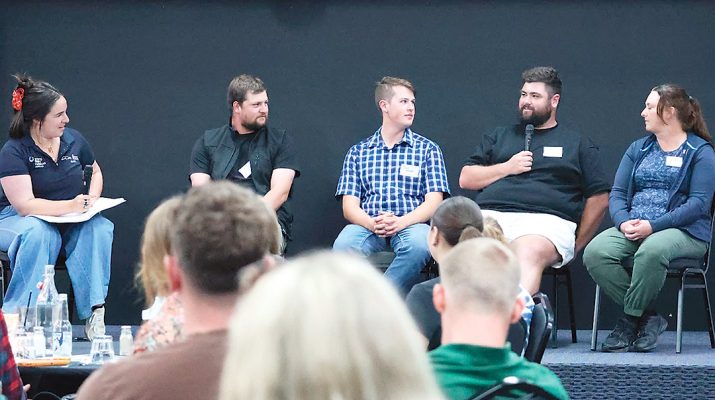
Last months Young Dairy Network (YDN) held a panel discussion, sharing farming experiences.
About 60 farmers from across the Gippsland region attended the event at the Morwell Club.
The ‘Career Pathway Panel Session: Discover Your Future in Dairy Farming’ featured four farmers of different backgrounds and experiencesand was moderated by YDN committee member for West Gippsland, Alex Boileau.
Ms Boileau is a dairy cattle vet, passionate about preventative health and productivity. She grew up in South Australia. Her experience didn’t start on a farm, she pursued an animal science degree, where her passion for cows grew.
After applying for vet school, Ms Boileau’s father convinced her to go into dairy veterinary care.
“(I) loved it. I loved my farm placement,” she told the audience.
“I got myself a job up in Queensland and absolutely loved it. But realised that if I wanted to progress a bit more and get some more contacts, then I’d better head south to the cold.”
Panellists at the YDN session included Luke Randal, Wendy Whelan, Tom Hooper, and Robert Hughes.
Ms Boileau highlighted that out of the four speakers, Mr Hughes was the only one who began his farming journey as a child, with his parents passing on the baton.
Now, for the panel discussion.
Tom Hooper
WORKING on a 200-cow dairy farm in Lang Lang, Tom Hooper is a 21-year-old farm manager.
Taking responsibility for pasture rotational contractors, Tom aims to take on more responsibility on the farm. Tom works full-time and has been on the farm for more than two years, starting as a second-in-command in a year, and before that, working casually three days a week.
While working on the two farms, Tom completed his studies.
Now, he runs some of his own heifers.
As a young farmer, he has found mentors incredibly helpful, especially for broadening his network.
“It feels like I don’t know what I’m doing,” Tom told the group.
“You just have to ask someone. I’ve got a couple of good mates that you just bounce ideas off, and you have a couple of really good friends around you to support you, whether it’s a boss or a mate.”
Originally coming from the concrete jungle, the mindset of where you are and who you are talking to became challenging for Tom.
He told the crowd that there have been times when he has wanted to talk about farming struggles, but his metropolitan friends haven’t been able to contribute to the conversation.
Tom said that being able to talk to someone about problems in farming was much needed.
Luke Randal
MANAGING James Clyde’s farm at Newry, Luke Randal has been onfarm for about six years, running1000 cows.
On the farm, Luke also manages nine staff members year-round and handles day-to-day farm duties.
Luke’s idea of success is simply being happy.
While he is “very competitive”, Luke said that as long as he is winning in some form, he is happy with how things are going.
“I like to win,” Luke said.
“I like to breed the best cows I can. I spend a lot of money and time on my cows, including genetics, embryos, and that sort of thing. It makes going to work really enjoyable.
“I’m very lucky that I can have my own cows on such a big farm. We’ve gone from having one cow that I bought six years ago, from the farm I was on, to now I’ve got 70 to 80 of my own cows.”
Being able to work his own cattle, Luke also welcomes his staff to have their own, even if it is just one or two.
He said he aims to make the farm work for all of them, and for the business to benefit, which helps draw more interest from those working.
Joining the bobby calf industry, Luke said that it brought a challenging start, but he sees opportunities for growth within it.
Among the growth opportunities, the panel turned to training and experience. When asked about his insight, Luke said that while he didn’t have a college background, he completed training.
“I was giving up all my spare time to go and get that training done, and piecing together the physical on-farm learning,” he said.
“Whereas you go to a TAFE, you have a room full of people that probably all have similar questions. My favourite people to employ on the farm are those not from the farm, because they don’t have the bad habits. It’s a great opportunity, and dairy provided me with such a good opportunity.”
Looking back at the “system,” Luke said there is a massive gap that needs to be addressed. Those just starting out can get lost on the farm because the training isn’t necessarily as accessible as it should be.
He said he has sent workers off for training, and a few have lost interest because it’s been so hard, and they don’t have a strong enough group mentality.
Wendy Whelan
WITH about 400 cows, Wendy Whelan owns a farm in Toora and started her dairy career as a relief milker at 19.
Up until four years ago, Wendy had been working as a systems manager on a share farm for about seven years before buying her own property.
Being highly goal-driven, Wendy measures her success by ticking off each goal.
For some goals, there can be obstacles standing in the way of success. Wendy used the weather as an example, as it is always changing.
Other success comes from work-life balance. To ensure she can take time away from the farm, Wendy competes in dressage.
“I like to compete in dressage with my horse, and they look at lessons from coaches, that sort of thing, that’s very powerful,” she said.
“(I) try to ride a lot. I try to catch up with friends, but it’s really hard to make that happen. Just about to leave, and stuff happens, but hopefully there’s a team of staff around you so you can do that, and then they can go and do that too.”
While finding time for things like hobbies and friends can be challenging, a greater struggle arose on Wendy’s journey.
After six months of share-farming, Wendy felt a tad off.
Brushing it off, thinking it was just the flu, it turned out to be a stroke. Wendy ended up in hospital, and even now, she told the crowd that she doesn’t recall those three weeks.
“I was in the neuro ward, and anyway, I got paralysed, and I couldn’t see properly,” she said.
“I had to do eight weeks in rehab, and all I wanted to do was to get back to the farm. My workers kept the farm going amazingly, and sent me pictures of my cows to inspire me. I worked really hard. It took me nine months to get back to three times a week. I just kept battling through.”
The experience taught her that work isn’t everything, and that balancing things out is really important – physically, socially and mentally.
When discussing industry growth, Wendy was asked for her thoughts on technological advancements. She told the group that it is great for the industry and will bring different skills and possibly a different group of people who might love animals but aren’t up for the industry’s physical challenges.
Wendy also highlighted that it is becoming harder to buy farms.
“The farm I bought was owned by owners who started with over 100 acres next door and another 100 acres they wanted to sell,” she said.
“It’s definitely harder than it was, but maybe there’s some opportunities for equity shares now, where you buy a part of a farm.”
Entering the farming industry, Wendy didn’t come from a farming background. She looked at apprenticeships and training opportunities to get her feet on the ground.
Unfortunately, Wendy said that online training methods didn’t help, as some in the industry lack literacy skills or don’t prioritise them over hands-on skills. She said that training opportunities for people in dairy need to be more hands-on and better tailored to the job.
Wendy encourages people to take in what they can, be a sponge, jump on learning opportunities, and continue to network through word of mouth.
Robert Hughes
ROBBIE Hughes share-farms more than 210 acres, milking 310 cows.
Growing up on a farm with his family, Robert, or Robbie, was inspired to pursue farming from day one, working for his parents over the years until he had enough money saved to buy his own herd.
Looking back on his success over the years, Robbie said that achieving his goals helped him look forward to the farm. Setting goals for farm ownership and his own herd, Robbie worked toward this.
“I’m just happy that I have achieved everything that I really wanted to,” Robbie told the group.
On the ground, Robbie spoke his success with pastures, saying that using silage has been more successful than topping, despite the challenges that followed.
Heading down a similar path to his parents, Robbie worked through a few challenges getting his farming adventure up and going. He said that throughout the journey, he had issues with bankers and communication, which tested his relationship with the previous share-farm owners.
