
Katrina BRANDON
LISTEN to your communities.
This message was sent to Parliament last month from Country Fire Authority (CFA) volunteers, farmers, transport workers, small businesses, and communities across Victoria.
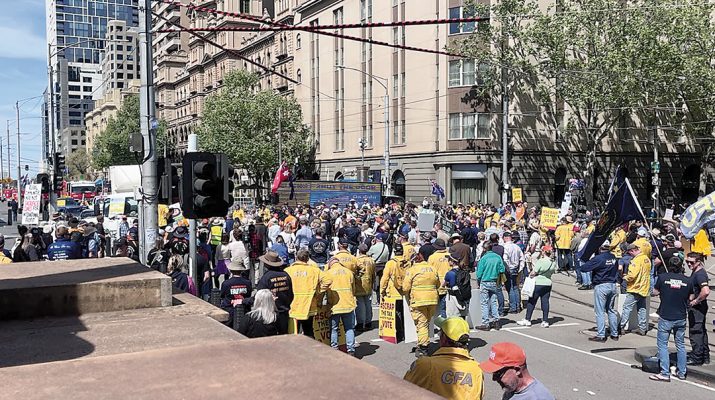
On October 9, a convoy of roughly 155 fire trucks attended a rally on the steps of Parliament House to voice concerns about increased pressure on communities across the state, including concerns raised by the Emergency Services and Volunteers Fund (ESVF).
“For us in regional Victoria, our voices don’t get heard a lot,” Bairnsdale CFA’s Captain, Jadon Dennis told the Gippsland Farmer.
“We thought it was about time to join the convoys down here and head to parliament to help share our concerns. A lot is going on recently that Melbourne doesn’t hear about, like pressure on farmers, new emergency services taxes, and outdated fire trucks. They were our two main reasons for heading down there.”
Many other Gippsland brigades also joined the convoy.
Over the years, Mr Dennis said CFA volunteers and farmers have already faced a lot of pressure, with many tempted to leave the organisation. He said that the issue isn’t new and has been ongoing.
For the CFA Volunteers Group (CFAVG), the rally offered an opportunity to highlight the need for stronger commitment to the people ready to protect Victoria’s communities.
CFAVG said this includes ensuring volunteers have the trucks, equipment, training, facilities, information and resources they need to respond safely and effectively, together with a sustainable funding model for volunteer emergency services.
“Last year alone, they said this $1.55 billion was raised out of that tax. Well, where is it?” Mr Dennis said.
“(They said) ‘We will build you 150 fire trucks’. Well, that doesn’t even scratch the surface. Over 680 single-cab, 30-plus-year-old fire trucks out there need replacing. Their promise was 150, and that doesn’t even give one per district down here.”
He highlighted that many stations in regional and rural areas were not fitted with hazmat or facilities required of a station (such as Hazelwood North CFA mentioned in the October Farmer edition).
“You wouldn’t get away with it it in a workplace,” he said.
“We don’t have change rooms, got one toilet. We’re only a small brigade, but if you’re going with the standards of today … it doesn’t meet any of those requirements. But because volunteers are still willing to do it, we’ve got to take the brunt of it.”
On top of being under-resourced, the ESVF is applying additional pressure.
The Emergency Services and Volunteers Fund is an annual property levy collected through council rates in Victoria. It applies to residential, commercial, industrial, primary production and public benefit properties. It replaced the fire services property levy and supports a broader range of emergency services.
Mr Dennis said that applying this tax to farmers was unfair.
“In Victoria, there’s over 150 taxes,” he said.
“We are the most taxed state; you can’t get ahead. Families can’t get ahead, and even generational farmers, where they have been handed the farm and don’t owe anything, are struggling to make ends meet.
“The bigger the acreage you’ve got, the higher the taxes. There’s some farmers that are up between eight and 10 grand a year extra on their rates, depending on where they’re situated and the value of their property.
“(The government should) get rid of the emergency service tax, show us where the money’s going and has gone from the previous 12 months, be transparent with what’s covered rather than just take and hit everyone with another tax.”
Recently, Victoria’s premier, Ben Carroll announced 150 new fire trucks as part of the election, with fire authorities and the auditor-general stating it is not enough.
According to the auditor-general, an investment of $1.5 billion is needed to maintain and replace the state’s fire trucks, with almost 60 per cent of CFA and Fire Rescue Victoria trucks being more than 15 years old.
While regional Victoria knows the situation all too well, Mr Dennis said it was time for metropolitan areas to understand the impacts of the taxes and where the money was going.
