
Katrina BRANDON
Balance is the key to life.
That is whether it’s balance in the paddocks or balance in our lives.
On July 3, Agriculture Victoria held a discussion session at the Korumburra Middle Pub, where farmers could network, meet new people, chat and have a nice warm meal.
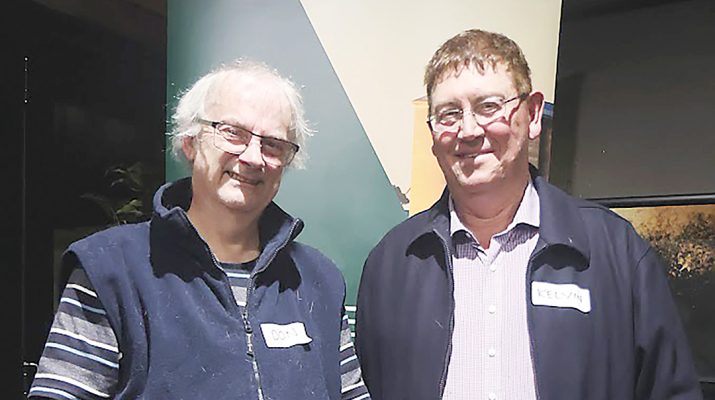
During the session, A Feed and A Yarn, farmers heard from Hazel Park dairy farmer Kelvin Jackson and Mirboo North farmer Don Hill about their experience on-farm.
A Feed and A Yarn sessions were also held at the Welshpool Hotel, Bairnsdale RSL and the Orbost Club Hotel.
About 25 people attended the session held in Korumburra around 6pm.
Getting the night started, the event organiser said the night was an opportunity for attendees to chat and check in on how others are going this season. With El Niño ahead, a dry summer behind, and fluctuating fuel and fertiliser prices, they had to address the challenges and find solutions.
Up first was Mr Jackson, who had previously dealt with drought conditions.
Mr Jackson’s dairy farm in Hazel Bank houses about 400 dairy cows. On the farm, Mr Jackson has a couple of staff members and a farm manager who helps with jobs he can’t necessarily do himself.
“The last year has been challenging,” he told the group.
“We have got a number of hay sheds, which were full of hay. We had about 1300 bales of hay last year, and by the end, we had 50 left, which is normally about three years’ worth. That was challenging.”
Bought in 1981, Mr Jackson started with only 90 cows. Mr Jackson leased the property next door to his farm, only to buy the farm a few years later.
Having bought up a few more lots of land over the years, Mr Jackson said that as the farm grew, he faced many challenges.
“I wouldn’t say it’s been easy,” he said.
“If you hang in there, you keep sort of trying to make the right decisions. For people who really want to (give it) a go, I think there’s a great future here (in agriculture).”
Mr Jackson said that one of the challenges he has faced is setting the farm up for the season, as no one is 100 per cent sure what it will bring. He said that at the end of the day, you still have to look after your cattle and your property, finding a balance that is somewhat flexible and easier to work with when challenges come along.
Balance is finding how many cows are too many for the block of land, with room to move with seasonal changes.
Besides farming, Mr Jackson is a longtime contractor, sowing other farmers’ grass and crops. On the job, he ensures that he talks with his clients about cattle and other farming topics, which he said can be a great learning opportunity.
“I love hearing their stories,” he said.
“I’m a positive person by nature, and I think it’s really important to get out there when you’re doing it tough, just get out there and talk to others.”
With that advice, Mr Jackson handed over the conversation to Mr Hill.
Getting out and about, talking to farmers, Mr Hill is helping with the Victorian Trees on Farm program, sharing knowledge on agroforestry, providing shade and shelter for livestock, improving soil and pasture health, and providing an extra source of revenue for farmers.
Mr Hill spent 20 years up in the Dandenongs. In 2005, Mr Hill’s brother was building a house there and thought that it was a nice place. Looking for something around the 20-acre mark, Mr Hill couldn’t find anywhere that suited his needs.
Branching off to a higher acreage, Mr Hill bought a 200-acre.
During that time, Mr Hill picked up a Weekly Times paper, where he saw an article by Frank Hirst, who had a farm in Ranceby in South Gippsland. The story went on to talk about his agroforestry operation, which Mr Hill said was “magical”.
“He planted wide-spaced trees, and had his cattle running amongst the trees,” Mr Hill said.
“The farm that we had bought was an ex-dairy farm with hardly a tree in sight. I thought that this was what we needed to do.”
After having a chat with Mr Hirst (who was featured in the Gippsland Farmer in April 2018), Mr Hill decided to plant trees throughout his property. During his first year, Mr Hill took the leap and got some livestock to feed between the trees.
After looking around, Mr Hill purchased 100 ewes from South Australia and later got some cattle.
As years went on, so did the number of animals on the farm.
In the 2000s, Mr Hill told the group that they would soon face a drought. With 200 animals on 200 acres, he ended up selling some stock, in particular, the sheep.
After the drought, Mr Hill bought a 50-acre property in Mirboo North, South Gippsland, where he also planted trees throughout the farm. Recently, he said that the planted trees were harvested.
“We’ve had a really good experience (with tree harvesting),” Mr Hill told the group.
“Last year, we saw this tree on a farm program advertised by the government … so we made contact with them, and it’s brilliant.”
The Trees on Farm program supplies a grant of $4000/ha available for up to 20 hectares. The program advises on the suitability of the properties to conduct one of these programs and to complete and submit the application on the property owner’s behalf. They do not charge for the program.
In addition to the Trees on Farm program, a carbon credits program runs in conjunction with it, which is suitable for the tree project and may be able to assign carbon credits. This would produce revenue for up to 15 years in addition to the Victorian Trees on Farms program.
Farmers retain full ownership and control of the land, trees, and carbon credits at all times throughout the program, with assistance from the Gippsland Carbon Plantations group from start to finish.
The group manages the regulatory process and ensures compliance with all requirements of the Climate Energy Regulator, including the Carbon Credits Act 2011, the CFI Rule 2015, and the Plantation Forestry Methodology Determination 2022.
“You can also get shelter, shade, and other benefits without ruining the emergency operation, and the studies show that in the dairy area, compared to our farm with no trees, a farm with tree cover, you can get five per cent more milk produced from the same cows,” Mr Hill said.
For more information on the Trees on Farm Program, go to agriculture.vic.gov.au/crops-and-horticulture/plantations-and-farm-forestry/trees-on-farms/victorian-trees-on-farms-program
