
Aidan KNIGHT
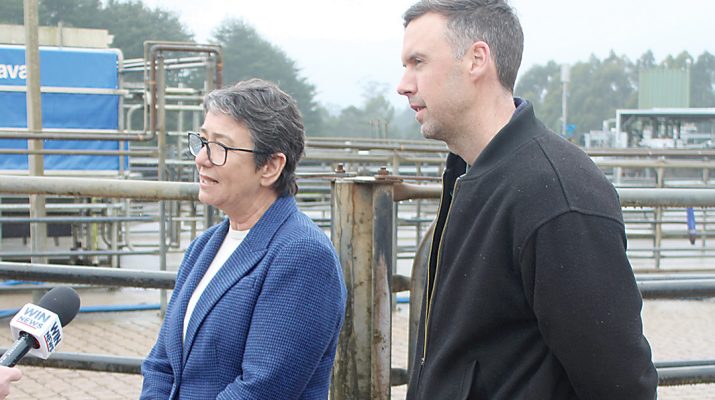
THE Minister for Agriculture, Michaela Settle, spoke with Gippsland Farmer recently during her visit to the Ellinbank Smartfarm in June for a series of announcements.
These included the Victorian Labor Government’s investment into RNA-based biopesticide projects for grapes and almonds ($1.7m), and mastitis vaccine research for dairy ($1.74m), all funded under the RNA for Agriculture program and centred heavily on work at Ellinbank.
The biopesticides targeted:
- Grape phylloxera – a serious grapevine pest that can have “devastating impacts” on the grape industry.
- Carpophilus beetle – a pest affecting the almond industry, which the minister noted as important for export trade.
- Mastitis research in dairy cattle at Ellinbank, focusing on: Identifying the bacteria that cause mastitis. Developing an mRNA-based vaccine to treat mastitis early and lift productivity in a dairy industry worth about $1.6 billion a year.
“I know that mastitis can have a really bad effect on that productivity,” Minister Settle said.
“This project’s going to look at the possibility of finding vaccines, so that we can make sure that we can treat it early before it has those impacts.”
She said the ultimate goal was a vaccine that could lift long-term productivity.
“Mastitis really does have a big impact on productivity, and being able to produce a vaccine will protect our fabulous dairy industry for many years to come, and really see an increase in productivity.”
Ms Settle said the RNA work on biopesticides was also part of a broader shift to reduce reliance on conventional chemicals.
“This program is very much aimed at trying to reduce the use of pesticides, so if successful, the biopesticides will replace traditional pesticides,” she said.
“It’s always something we look to, and this project is a great example of a future without pesticides.”
The minister stressed that any new vaccines or biopesticides would be subject to rigorous safety testing. There would be “extensive work” from lab to paddock “to make sure that it has no impact on animal welfare and, of course, on the milk that we all love and depend on,” she said.
Gippsland Farmer asked about irrigators in the Latrobe Valley who fear they will lose access to water from the Latrobe River if it is used to fill the Hazelwood open–cut mine, Ms Settle said she understood the anxiety.
“I understand concerns – obviously, in irrigated farming, water is the lifeblood of your productivity,” she said. She pointed to the ongoing Environmental Effects Statement (EES) process for the Hazelwood fill project.
“The EES is underway on that project, the filling project, and the EES role is to really look at any implications environmentally and to the agricultural sector,” she said.
Ms Settle said the Minister for Water was “very conscious of the need for water in this area” and noted that “just last year … there was a 16 billion litre allocation that was made as a result of not using that water in the energy process.”
Answering our further questions regarding rising input costs, including fertiliser and diesel, Ms Settle assured the publication that government knew the pressure farmers were under.
“We understand the input costs are having a real impact on our farming communities, and we’re all very alive to that,” she said.
She pointed to coordination between the Victorian Energy Commissioner and the Commonwealth, as well as recent federal bulk purchases of urea.
“There’s a lot of work going on with our Victorian Energy Commissioner working with the federal government. It’s really important that we have a consistent approach to this issue,” she said.
“I’m very pleased that the federal government have made some really big purchases around urea, including the 250,000 tonnes that they announced a little while ago, and of course, just in the last
couple of days, a further purchase of urea.”
At the same time, Agriculture Victoria is exploring longer-term options to boost fertiliser resilience. Admitting there is no “one size fits all” answer to fertiliser, Ms Settle cited Ellinbank’s own waste-to-nutrient system as an example.
“The farm here uses a project whereby the waste management – the nitrogen stays in the waste management – and then can be used on the pastures,” she said.
Ms Settle, who has previously served as Parliamentary Secretary for Agriculture, said she brought both personal and professional experience to the role.
“I’m really delighted to be the Minister for Agriculture,” she said.
“I was lucky enough to be the Parliamentary Secretary for quite a few years, and I’ve said to a lot of people, these aren’t portfolios for me, they’re passions.”
With new research under way at Ellinbank and ongoing debates over water and input costs, Gippsland’s farming community will be watching closely to see how those passions translate into policy on the ground.
