
Stefan BRADLEY
FOOD and agribusiness bank, Rabobank, had some of their research team members in Sale in March to meet with clients and to learn from one another to figure out what is going on locally and internationally in the wake of the war in the Middle East.
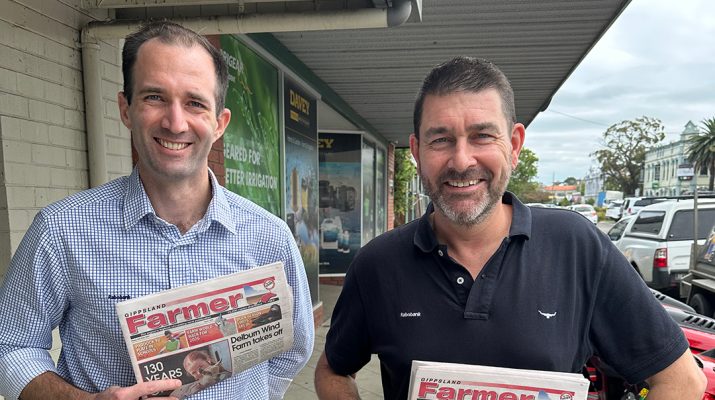
Senior analyst for dairy and consumer foods Michael Harvey and senior macro strategist Ben Picton spoke to the Gippsland Farmer on March 18 to discuss this.
Almost a year ago Mr Harvey was speaking to the Gippsland Farmer about another sudden market shock – US President Donald Trump’s so-called ‘Liberation Day’ tariffs.
During their Gippsland tour, Mr Picton was the person to ask about geopolitics, the implications of the US/Iran war for Australia and the outlook for interest rates.
“What we’re seeing is a continuation of this theme of geopolitics driving markets – not just commodity markets, but also interest rate markets and foreign exchange markets as well,” Mr Picton said.
“The Reserve Bank of Australia (RBA) did lift the cash rate yesterday (March 17), but the governor, Michelle Bullock, was at pains to tell the journalists at her press conference that it wasn’t because of the war in Iran. Australia had an inflation problem leading into the war.
“The RBA’s target is 2.5 per cent. Inflation is running at 3.8 per cent. The reason why is because demand is exceeding supply. Raising the cash rate helps to clamp down on growth in demand. Now, because we now know that we’ve got a supply shock coming from the war with fuel prices but it’s also going to hit supply chains in other ways as well.
“That means that what’s likely to happen is the gap between demand and supply is actually going to be bigger than what they first thought. So the risk from the war is that the RBA is going to have to raise rates further and maybe faster than they otherwise would have, in order to try to bring the economy back into balance.”
Mr Picton said that diesel is the “most important transport fuel in Australia”, and the “main fuel for industry”.
“Trucking and agricultural machinery runs on diesel. As a country, we consume almost, or roughly, twice as much diesel as we consume unleaded petrol. And diesel was already in a slightly tighter supply environment than unleaded petrol, because global demand for diesel continues to grow every year, whereas demand for unleaded fuel is reasonably stagnant,” he said.
“So we already had a little bit of tightness in global diesel markets, and now all of a sudden, we’ve lost a big chunk of supply. So it is concerning.
“If you think about Australia in general, we have a reasonably high dependence on liquid fuels just because we have the tyranny of distance. We have a large road freight sector because we have a big country. We also consume a lot of jet fuel, and bunker fuel in shipping is a reasonably substantial supply chain cost for us as well. So we’re a very oil-intensive economy just by the virtue of our geography and where we are.
“But what I would say is that the oil intensity of the Australian economy has fallen a lot since the 1970s when we used to have oil shocks back then. We’re only around 40 per cent as oil-intensive as we were in the ’70s. So things have gotten better, in a way.”
Much of the discussion regarding the effective closure of the Strait of Hormuz has been the impact on oil and gas prices, but the sudden increase in the cost of fertiliser is no joke.
“When we’re looking at fertiliser prices, there are indexes that we can look at for urea prices coming out of the Middle East, and they’ve moved up by 40 to 50 per cent roughly… since the start of the war,” Mr Picton said.
Liquified natural gas from Qatar acts as a feedstock to produce urea fertiliser. And, according to the United Nations Trade and Development, one third of global fertiliser passes through the strait.
Mr Harvey said the bank’s dairy clients across Gippsland were mainly interested in talking about the war’s impact on costs of production, as well as the June 1 farmgate milk pricing, which they hope
will mitigate potentially lower margins.
“Cleary (the war) has direct impacts in terms of fuel and fertiliser straight away. But I think dairy clients are now starting to think about June 1 pricing and what that might look like in a few months’ time,” Mr Harvey said.
“There is a positive story in the global market for dairy in the sense that commodity markets have picked up a little bit. They started this year off a weak base, but that provides a better footing for what might happen on June 1 pricing. That will be needed because it’s still a high cost of production environment for dairy farmers, with the risk that things get a little bit worse before they get better.
“Milk production growth in all the major export regions except Australia has been very, very strong because of a perfect storm of high milk prices, low feed costs, good seasonal conditions, and no disease this time around in the Northern Hemisphere, unlike 12 months ago.
“Lots of milk puts some pressure on commodity values, and that’s been the cycle. But we’ve seen that uplift more recently because you get the short-term buying opportunity where importers have to buy products at a lower price. But that’s where the Middle East conflict comes in as well, because they are a large import region.”
Mr Harvey said dairy farmers were already dealing with higher bills thanks to the increasing costs of processing, distribution and packaging costs.
“Good seasonal conditions go a long way in terms of lifting homegrown feed availability, which then potentially reduces your need for imported feed and fertilizer and things like that,” he said.
Mr Harvey said the biggest issue is supply availability.
“Farmers and dairy farmers will be able to manage higher prices and budget their way through that. It’s more around the risk of actually not having what you need when you need it,” he said.
