
Stefan BRADLEY
VIRTUAL fencing is going Australia-wide, with New Zealand agricultural technology (agtech) start-up Halter seeing their patented technology quickly adopted by beef and dairy farmers to virtually fence and shift their cows with electronic collars.
Halter set up an information session and demonstration in partnership with Ross Anderson at his dairy farm Anderlea Dairy in Denison on May 27, which was attended by over 80 people interested in checking out this new shift in agtech.
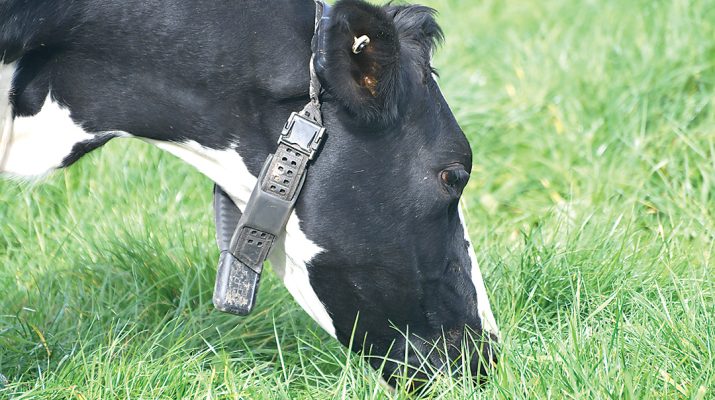
Mr Anderson is the first Victorian farmer to use Halter’s ground-breaking product, which involves each cow wearing a solar-powered electronic collar controlled by a smartphone app to move the herd from break to break. Farmers use the app to draw the virtual boundaries, with the collars moving the cows with vibrations and sounds. Labour that had to be done in person can now be done remotely on the app.
This technology is brand new and has been affected by the various state legislations around the country due to the collar technology being lumped in with illegal shock collars – although some states were unregulated and posed no problems. Lobbying efforts have led to legislative changes, including in Victoria late last year, and now Halter’s app and collar are legalised everywhere.
Hamish Irvine from Halter said the company has been working hard with farmers, starting in Tasmania and moving to the mainland. The company recently branched out into collars for the beef industry, which uses different software than for dairy herds. It’s Halter’s algorithm, or what they refer to as Cowgorithm or CowG.
Mr Anderson said he first became interested in Halter’s virtual fencing since he became aware of it five years ago.
“I’ve watched it from afar … and wondered why we weren’t allowed to have it,” Mr Anderson said.
“But as soon as it was allowed (in February), we were pretty keen.”
It’s now been over 100 days since the technology was fully legalised for use in Victoria.
Mr Anderson said he never imagined that he’d be “moving the cows around the farm with collars and running our farm almost off an app”.
The attendees were taken out to where the cows were and sure enough, Mr Anderson made them move with the app where the virtual boundary was set.
The cows moved to a virtual line and did not go past it. He showed on-screen the app and how it could be used to track each cow’s health and signal them where to go. No strip fencing required. There’s no need to jump on the quad bike and spend so much time sitting behind cows.
Some of the existing physical fencing has already been removed from Anderlea Dairy, but Mr Anderson says he still believed they had a role to play in his operations.
It takes the cows about three days to be accustomed to living with the collar, but training usually continues for up to 10 days to be sure the cows are properly responding to the virtual boundaries. Electric pulses can be used, but are predominantly used in the initial training, and Halter says the pulses are lower voltage than electric fencing.
After about 10 days Mr Anderson’s farm could push cows away from the dairy back to the paddocks. He said the technology had saved the farm three hours of labour a day, allowing more breaks for staff throughout the day, or shorter work days in general.
“We get an extra hour (of sleep) in the morning,” Mr Anderson told the Gippsland Farmer.
“Historically, we would have got up and had the cows at the feedpad by 3.30 (in the morning). Now we just send the phone to have the cows there at 3. And instead of getting up and leaving the home at 3, we get to the dairy at 4 and the cows are already here.”
Without the collars, time would have been dedicated to locking the cows after milking and bringing them to the feedpad.
“At the end of the day, we don’t have to follow the cows home and lock them in their paddock. They go by guidance.” Mr Anderson said.
“We’re getting home for dinner and it’s still warm. We’ll get an extra hour of sleep in the morning. Hard to put a price on that sort of stuff.”
What are the potential downsides? This startup now has access to all your data.
More than 1 million cows are wearing these Halter collars, across 2000 farms in four countries: Australia, New Zealand, Canada and the United States.
With rural areas not having the best connectivity, Halter partners with Starlink satellite technology, which is operated by SpaceX, to ensure farmers have access to the information on the app when they need thanks to a solar-powered tower installed on the farm.
A Halter spokesperson told the Gippsland Farmer that Starlink is the conduit just like any telecommunications company relaying data around the world daily, and all that data sent to and from the Halter servers is fully encrypted with “industry-standard” technology.
“Halter takes our customer’s data privacy very seriously, and has protections in place to keep the data safe. Nobody besides Halter and the farmer has information on their farms, and we don’t share Halter data with third parties or for commercial purposes,” the spokesperson said.
In late March, the Australian Financial Review reported that Halter was now worth more than $2.9 billion after tech billionaire Peter Thiel’s capital firm Founders Fund invested in the start-up, alongside Bond Capital and Blackbird Ventures. Mr Thiel is known as a co-founder of PayPal and Palantir Technologies.
Halter also uses AI technology within its app to help with monitoring herd movement and health. Mr Anderson demonstrated an AI assistant but it also had an option to connect with an actual Halter staff member.
