
Katrina BRANDON
FARM succession is often messy and brutal, but according to a half-farmer, half-lawyer, Claire Booth, it doesn’t have to be that way.
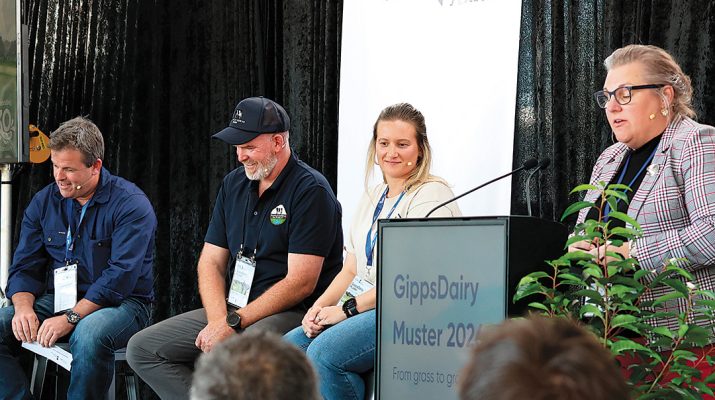
At the 2026 GippsDairy Muster in Toora, Claire Booth was invited to speak and to join a panel to share how succession planning can be made easier for farming families.
For 20 years, Claire Booth has worked as a solicitor, working with family and farming businesses across NSW and Queensland. In 2011, Ms Booth established BoothAg, a mixed farming operation producing irrigated crops and breeding Angus cattle.
Claire has worked in the legal sector since 2003 and now specialises in wills, succession planning, and trust law, with expertise in water law and irrigated agriculture.
“Succession is literally just a bank refinance opportunity,” she told the crowd of 185 people.
“Every bank loves the word succession. It is your legacy to be so, and that’s why today is an opportunity for you to step into your power and say to yourself, ‘What things can I control today?’”
According to Ms Booth, tax is one of the key issues for people with assets acquired after 1985, where many dairy farms are “pregnant” with unrealised gains. She said that there are farmers who are good producers but miss out on opportunities because they lack expertise in tax law.
During her time, Ms Booth told the crowd that there had been some “horror stories” in which families are not talking to each other and lawyers are drawing large sums of money from them.
Often, it is seen as too hard and as something the farming family “doesn’t have money for”, so they just avoid it, risking a crash down the road.
“There are so many things that you can do, small and big, that will ensure the success of what you’re about to do,” she said.
“Today (April 23) is not about giving you the solution. It’s about the succession of the balance sheet and making sure that the family has things from that they can do to get them ready so that they can have that incredible outcome.”
Ms Booth told the crowd that after the event, the farmers should go to their advisers (lawyers, accountants, bankers, insurance professionals), to ensure they get the best for their business.
As a first-generation farmer, they set up a small business and borrowed 85 per cent of the funds before the Royal Commission. At 28, she said that they were still young enough to take the risk and start again.
During that time, she had some personal struggles and decided to focus on what she could control, such as buying farms. Now, after 15 years, she owns five irrigated properties and has an agriculture business selling potatoes.
To get there, she said, a lot of planning was involved. Ms Booth said, “Hope for the best, but plan for the worst.”
“Just because your folks or your grandparents or your neighbour had a really tough time, just remember when it is your turn, you can always approach your pathway differently than what happened to you,” Ms Booth explained.
“You can prevent any of your life’s wealth and any of your forefathers or foremothers or grandparents’ wealth going into the legal profession, if you are proactive and engage in change and have a plan.”
- During the event, Ms Booth took the group through a case to show what can happen, the approach they took and how they could do things differently.
- Looking at different ways of approaching succession planning, Ms Booth provided questions to help think about in succession plans, such as;
- Have you spoken with your bank about succession?
- Do you actively manage people, animals, or/and/or crops?
- Do you want to share the family wealth between on-farm and off-farm?
- Do you have a tax impact statement?
- Do you know which farmland is pre- or post-CGT?
- Has the accountant provided tax advice regarding CGT, forgiveness of UPE/loans, etc?
- Do you know about the Regional Investment Corporation (RIC) succession loads?
- Has your accountant advised the client about capital gains tax (CGT) on the transfer of farmland before and after your death?
- Does your will/EPOA/BDN reflect your succession plan?
Ms Booth then welcomed Ken White, Clint, and Tania Staley to a panel discussion to share their experiences.
