
Katrina BRANDON
STRENGTH starts with collaboration and networking.
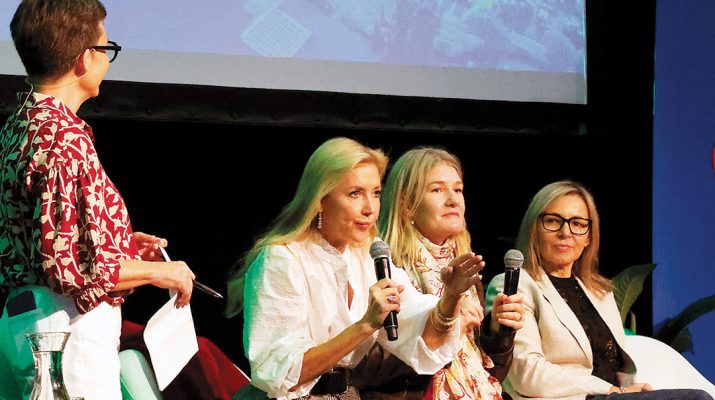
At Farm World 2026, Telstra hosted a Women in Agriculture luncheon, welcoming about 215 attendees from across the board, welcoming leaders and everyday people to network.
Former chair of Lardner Park, Ange Bailey, opened the event.
“This event started in 2012 under the guidance of Angela Betheras, who was a board member at Lardner Park,” Ms Bailey said.
“The event was started because we wanted to do something that is all about women at an ag-show. Women are very, very important, not just in agriculture, but in every walk of life.”
Ms Bailey talked about the importance of women of all walks of life, whether it be business owners, leaders, farmers, stay-at-home mothers and more, to talk to other women, to help bring passions together and opportunities to network.
Bringing in a local leader, Ms Bailey welcomed Telstra’s Regional Australia Executive, Loretta Williston, to draw on the experiences that shaped who she is today.
Ms Williston told the crowd about her rich history in the area, originating from Jeeralang Junction, just out of Churchill.
“I was one of six children, and life wasn’t about convenience,” Ms Williston said.
“There’s something about growing up outside of big cities that shapes your perspective early; you learn quickly that nothing is handed to you. If something breaks, you fix it.”
Coming from a regional area, Ms Williston said that it has helped her become a better leader, work as part of a team, and continue her journey with a strong work ethic, pushing her into opportunities where she wasn’t necessarily comfortable.
She reminisced about her first part-time job at a coffee shop in Mid Valley, her jump into the workforce and the brutality of what was and what is now the current state of employment in regional areas.
Feeling lucky, Ms Williston applied for a job and was accepted as a business administrator at a company that her father was running.
“I was determined to prove myself,” she said.
“I didn’t want anyone to think that I’d been handed an opportunity, and I felt an obligation to deliver, and I worked harder than those around me to earn my place. That’s when I learned that resilience isn’t about avoiding tough moments, it’s about moving through them.”
Ms Williston said that it was about how you showed up and showed yourself; that things don’t always go according to plan; that it is about how you navigate those challenges; and that failure is a part of success.
Going into the challenges, whether in life or in the workplace, she also said it is about asking the “right” questions and trusting your team and the decisions you make.
A main challenge Ms Williston faced in the employment line was being the only woman in the room at times, and, as a leader, she found that difficult. Working through that, she led with her indifference, using the challenge to push herself forward and turning the negative into a positive.
Bringing the conversation back to agriculture, Ms Williston said that, like the workforce, both agriculture and telecommunications are rapidly changing.
Upon taking up her position at Telstra, Ms Williston said she aimed to focus on agricultural telecommunications.
“Connectivity is critical to every industry,” she said.
“From precision farming to supply chain management, from weather data to remote operations, technology plays an increasingly vital role in how agriculture operates and grows. In fact, that’s what led me, during my MBA, to focus my research on the barriers to technology adoption.”
In this role, she learned that leadership isn’t about having all the answers, but about creating an environment where others can succeed and allowing for voices to be heard.
Looking at women in agriculture, Ms Williston said she admires their ability to balance complexity and that they aren’t just managing businesses but also families, communities, and often other roles in between.
She highlighted that the ability to juggle all of those positions is a sign of good leadership.
“Coming from a regional background gave me a foundation, but it didn’t define my feelings,” she said.
“Your environment shapes you, but it certainly doesn’t define you. The second lesson says yes to opportunities even when you feel uncomfortable. Growth doesn’t happen in your comfort zone. It happens when you stretch yourself, take on challenges that push you, and learn and evolve.”
Her final note said that success is not a solo journey but is built on connections, collaboration, and support, while remaining resilient in the face of what comes your way and asking for help where needed.
Speaking next was State Opposition Leader Jess Wilson.
Ms Wilson highlighted the struggle among business, leadership, and family from a farming perspective. She spoke about her connection to regional Victoria and her hopes for the state’s future.
“I truly do believe in this state’s potential, but I know we weren’t reaching our potential, and when I talk to people across this state, I’m worried that the optimism that was once a mark of being the bitcoin is seeping away,” she said.
As a new mother, Ms Wilson noted that she loves the state and despite the challenges it faces today, she said she wanted her family to feel the same. She highlighted challenges such as the current cost-of-living crisis and safety concerns in communities across the state.
Ms Wilson then said that it was the leaders who could help bring about change and drive movement to make Victoria a better place for all.
Looking up at the next speaker from the event, The Flying Vet, Dr Ameliah Scott, took to the stage.
Dr Scott’s journey is not unusual for her family, as she is a fifth-generation farmer and third-generation pilot based in a very rural area.
Out on a sheep and cattle station in New South Wales, Dr Scott’s nearest town has less than 200 people, and the nearest centre is over 300 kilometres away.
Living in an isolated area, Dr Scott regularly saw aeroplanes used for work, which spurred her dream of becoming a flying vet. As a vet on the ground, Dr Scott would spend a week on the road, working out of her car, providing regular mobile veterinary service to the far west of NSW.
Outside of this, she flies out to stations for pregnancy care, testing on cattle breeding evaluations, on bulls and other livestock consultancy work. In a week, Dr Scott will travel up to 4500 kilometres per week, stopping in towns along the way and mostly on dirt roads.
From the air, while she doesn’t have much carry capacity, she cuts the time it would take to drive to some areas by a third, despite other challenges such as cost and the lack of air conditioning.
A large part of Dr Scott’s life is driven by her father, who was unfortunately wheelchair bound and told that he’d never walk and never have children. He later went on not only to have children but to be a great pilot.
“(It’s a) real inspiration to see him do what he does every day. I learned from him that there are no excuses to quit and just to get on with it,” she said.
Another inspiration in Dr Scott’s life is her brother, who unfortunately passed away in an accident when he was 18. She had lost her best friend, but this wouldn’t stop her from flying towards her dreams.
Flying and driving around, Dr Scott said every day is a new adventure as the Flying Vet, with services such as Telstra aiding to make her job somewhat easier.
Final, but not least, Australian TV Presenter Catriona Rowntree took to the stage, talking about her journey as an agricultural journalist.
Originally coming from a small town just out of Tamworth, Ms Rowntree is no stranger to the agricultural world. She later moved to the city with her father. Ms Rowntree’s father was a farmer who fell in love with a city chick.
Later on, Ms Rowntree did the opposite.
Leading into the main reason she was at the Telstra event, Ms Rowntree highlighted her biggest hobby and talent to the crowd: talking.
As the youngest of four, Ms Rowntree felt she needed to be loud and constant, which soon led her to speech and drama. She later learned how to project and to control her voice, strengthening her abilities.
From a young age, Ms Rowntree wanted to become a journalist, in particular a TV presenter. While she got her dream job, it wasn’t as easy as just jumping into it.
Without the marks in school and the support from her school, she left, not expelled, for always talking in class. Moving to a different school, one teacher said she could get paid for talking, and then she did.
Ms Rowntree studied journalism at McLeay College and did as much work experience as she could. Ms Rowntree started in radio but auditioned for Channel 7, losing the opportunity to Tara Brown.
While she was continuing to build her skills in community radio, a storm gave her a three-hour opportunity. Other opportunities also sparked the way when Ms Rowtree moved into TV.
Jumping at anything that came her way, she jumped between radio and TV, but some came to her, just one call away.
Having been on TV for 35 years, Ms Rowntree’s career led her to What’s Up Doc, where she met Steve Erwin, then to Getaway. She ended up writing multiple farm stories while living on the road.
Leading up to the moment when she met her now-husband, a friend was dating a farmer in Warragul, and they had planned to get together. Meeting the farmer’s friend, they soon formed a connection, which led her to move to a grain and sheep farm near Geelong.
Ms Rowntree left the conversation, highlighting the need to shine a light on agriculture, that there are no stupid questions, and that the next opportunity may just be a phone call away.
